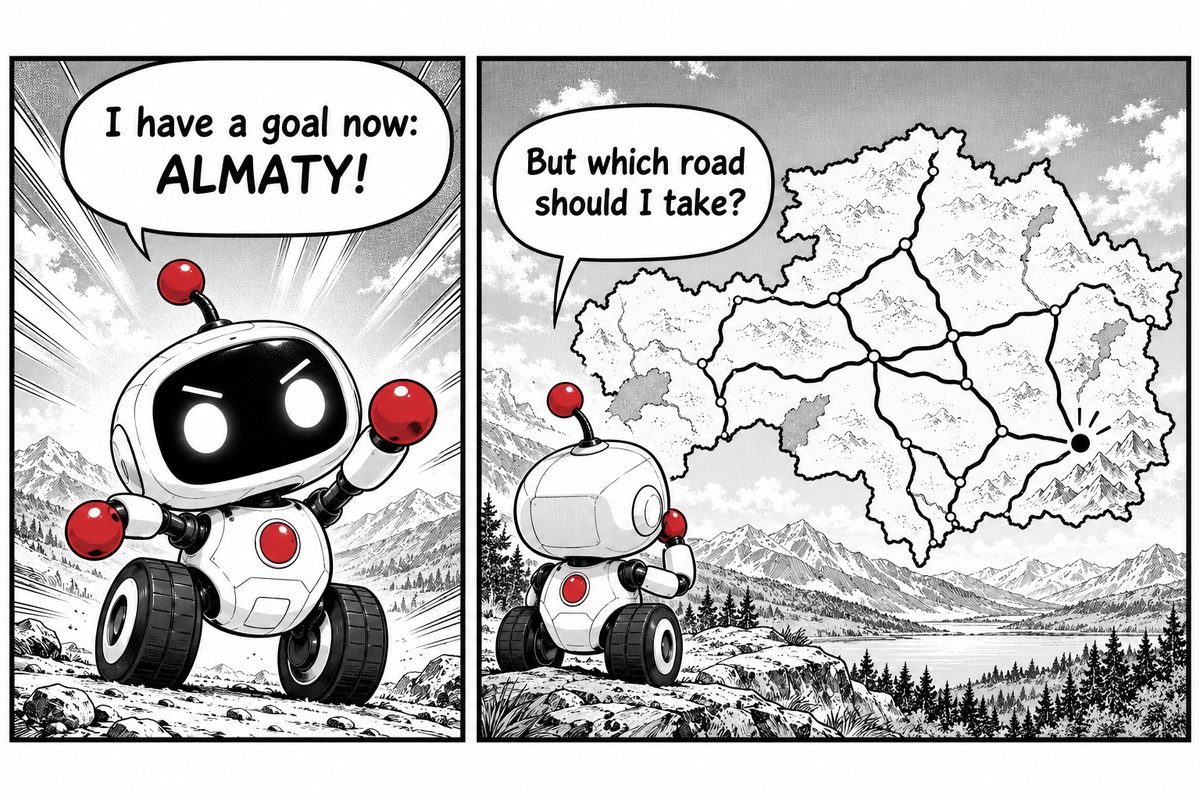
Agents & Environments
Perceive → decide → act. Repeat. That loop is every AI system you will ever meet.
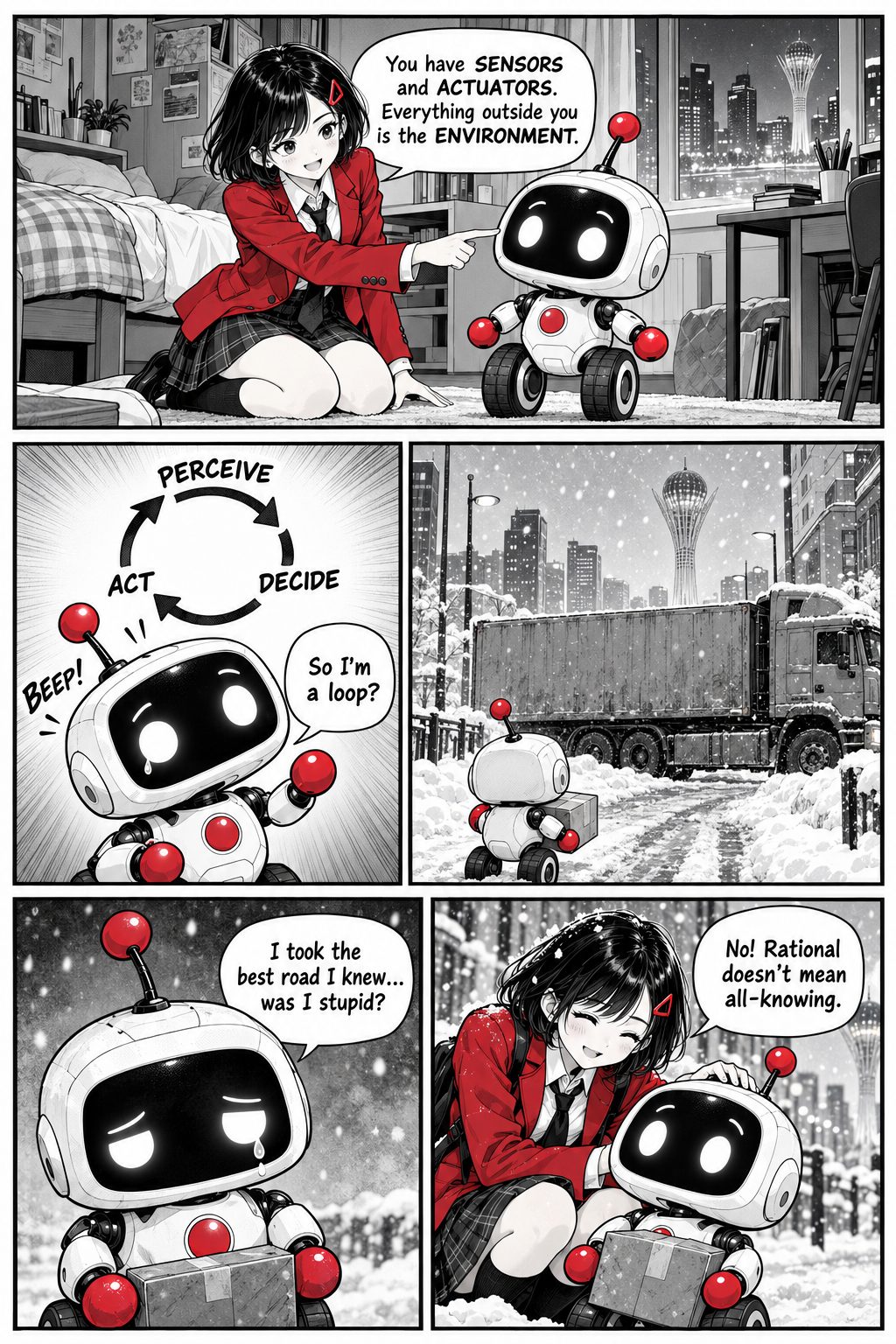
The agent–environment loop
An agent is anything that perceives its environment through sensors and acts on it through actuators. What the sensors deliver at one moment is a percept. The full history of percepts is the percept sequence. The agent's behaviour is described by its agent function, which maps percept sequences to actions. A program running on real hardware implements that function.
Key subtlety: sensors give evidence, not the whole truth. A camera doesn't show what is behind a truck. A thermometer says "38 °C", not "the motor is about to fail". Much of this course is about acting well despite that gap.
PEAS: describe the job before the algorithm
Before choosing any algorithm, engineers write down the task environment with PEAS: Performance measure, Environment, Actuators, Sensors.
Example: Bota as a delivery robot on Astana streets
| Agent | P | E | A | S |
|---|---|---|---|---|
| Self-driving car | Safety, travel time, comfort | Roads, traffic, weather, pedestrians | Steering, throttle, brakes | Cameras, radar, lidar, GPS |
| Pac-Man | Score, survival, completion | Maze, ghosts, pellets, power-ups | Move up/down/left/right | Grid position, visible maze, events |
| Chess player | Win, avoid loss, position | Board, opponent, clock | Choose a legal move | Board, move history, clock |
PEAS is a "job description" for the AI. If you can't say how success is measured (P), you can't know whether your AI is good.
Rationality
A rational agent chooses, for every possible percept sequence, the action that is expected to maximise its performance measure, given the evidence so far and whatever built-in knowledge it has. Rationality depends on four ingredients:
- Performance: what counts as success?
- Beliefs / prior knowledge: what does the agent expect about the world?
- Actions: what can it actually do?
- Evidence: what has it observed so far?
We judge a decision by the information available before acting, not with hindsight. An omniscient agent would know the actual outcome, and that's impossible in real tasks. A rational agent should still gather information (look before crossing the road) and learn from experience.
Classifying environments
The properties of the environment decide which algorithms work. The six main dimensions:
| Dimension | One end | Other end |
|---|---|---|
| Observability | Fully observable: sensors show everything relevant | Partially observable: sensors show only a slice (or nothing: unobservable) |
| Agents | Single-agent | Multi-agent: competitive (chess) or cooperative (robot team) |
| Uncertainty | Deterministic: same state + action → same next state | Stochastic: one action can have several outcomes. With opponents, outcomes are also strategic. |
| Time structure | Episodic: each decision is independent | Sequential: current choices change future options |
| Change | Static: the world waits while you think | Dynamic: the world changes while you decide |
| Actions/states | Discrete: chess moves, grid steps | Continuous: steering angle, torque |
| Task | Observable | Agents | Deterministic? | Episodic? | Static? | Discrete? |
|---|---|---|---|---|---|---|
| Crossword puzzle | Fully | Single | Deterministic | Sequential | Static | Discrete |
| Chess with a clock | Fully | Multi | Deterministic (strategic) | Sequential | Semi-dynamic | Discrete |
| Taxi driving | Partially | Multi | Stochastic | Sequential | Dynamic | Continuous |
| Medical diagnosis | Partially | Single | Stochastic | Sequential | Dynamic | Continuous |
| Defect detection on photos | Fully | Single | Deterministic | Episodic | Static | Continuous |
The hardest case is partially observable, multi-agent, stochastic, sequential, dynamic and continuous, which describes driving on Almaty roads in winter.
Poker: is it fully or partially observable?
A spam filter judging one email at a time: episodic or sequential?
A robot vacuum on a carpet where wheels sometimes slip: deterministic or stochastic?
Four agent architectures (and one bonus)
From simplest to richest. More structure means smarter behaviour but more computation and design effort.
1 · Simple reflex
Acts on the current percept with IF–THEN rules. Fast and interpretable, but brittle: it forgets everything it saw before.2 · Model-based
Keeps an internal state to remember what sensors can't show now ("the car behind me is still there").3 · Goal-based
Imagines future states and plans a sequence that reaches a goal. This is where search (Ch. 2) comes in.4 · Utility-based
Goals aren't enough when outcomes differ in quality or are uncertain. A utility scale lets the agent trade off speed vs safety (Ch. 5, 8).★ Learning agent
Any of the above plus a learning element that improves performance from feedback (Ch. 5, 8, 9).A pure reflex rule "run away from the visible ghost" can trap Pac-Man in a dead end. Good moves depend on what happens after the move: escape routes, power-up timing. So Pac-Man needs goal-based or utility-based reasoning.
Try it: a simple reflex agent
The lecture's smart-office agent in Python:
def office_agent(temperature, co2, people):
    if people == 0:      return "Energy-saving mode"
    elif temperature < 20: return "Heating ON"
    elif temperature > 26: return "Cooling ON"
    elif co2 > 1000:       return "Fresh-air fan ON"
    else:                 return "No action"
Action → No action
Try temperature 18 and CO₂ 1200. Two rules match, but only the first one fires. Now swap the order. Rule order is part of the agent's design.
Bridge: from reflexes to search
When rules aren't enough, a goal-based agent describes the problem formally as a search problem:
- Initial state: where the problem starts (Astana)
- Actions: legal moves (drive along a road)
- Transition model: the result of an action (now in Karaganda)
- Goal test: have we arrived? (Almaty?)
- Path cost: how expensive the solution is (sum of road costs)
The design workflow from the lecture: PEAS → environment taxonomy → representation → architecture → evaluation.
A thermostat is a genuine (very simple) reflex agent: one sensor, one rule, one actuator. Many "smart" home devices are still reflex agents with more rules.
1. Bota remembers that a road was closed yesterday, even though it can't see it now. Which architecture needs that?
2. Which PEAS element is "number of parcels delivered on time"?
3. A rational agent…