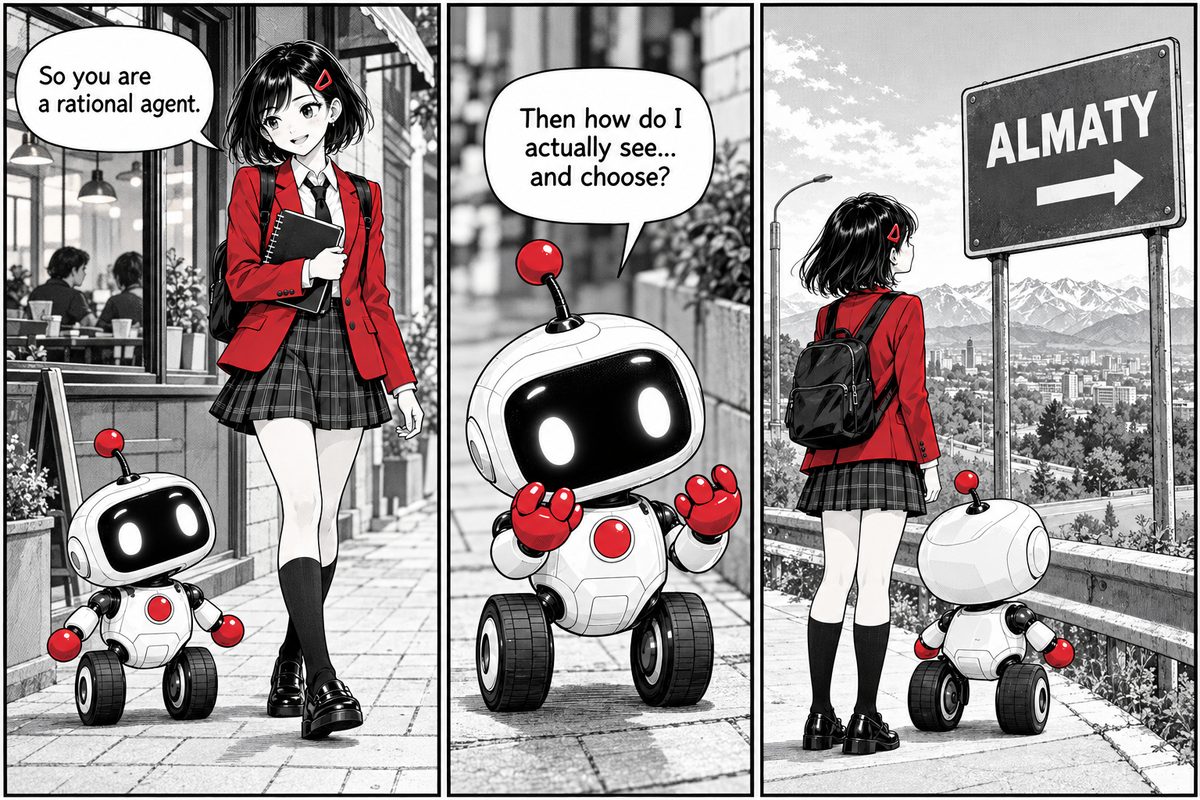
What Is AI?
Before Bota can travel, it has to understand what kind of creature it is.

Four ways to define AI
Artificial Intelligence (AI) is the field that builds computer systems able to do tasks that normally need human intelligence: perceiving, reasoning, planning, learning and acting. Russell and Norvig, authors of the main AI textbook, sort definitions along two questions. Do we care about thinking or acting? Do we measure success against humans or against an ideal of rationality?
An AI is a program that looks at its situation, decides what to do, and acts to reach a goal as well as it can with what it knows. It doesn't have to think like a human. It just has to make good decisions.
The Turing test (1950)
Alan Turing asked: instead of "Can machines think?", ask "Can a machine behave in conversation so that a judge can't reliably tell it from a human?" Passing such a test would need natural-language processing, knowledge, reasoning and learning. Today's chatbots can sound very human. Yet researchers no longer treat "fooling people" as the main goal, because sounding smart is not the same as being correct or useful.
AI, Machine Learning, Deep Learning: which is which?
Many AI systems contain no learning at all. The A* route planner in Chapter 2 and the chess-style minimax player in Chapter 4 work from rules and search. Machine learning (ML) is the part of AI where the program improves from data. Deep learning is ML with many-layered neural networks (Chapter 9). Large language models such as ChatGPT sit inside deep learning (Chapter 10). Generative models in general can use deep learning or simpler statistics: Chapter 10's tiny bigram text generator just counts words.
Narrow AI vs General AI
Narrow AI is excellent at one task: a spam filter, a route planner, a Go player. Artificial General Intelligence (AGI) would match humans across almost all tasks. Every system that exists today, including the most impressive chatbots, is still evaluated task by task, and whether any of them is "general" is an open debate.
A short history of AI
Tap a year to open the story. Red dots are breakthroughs; blue dots are "AI winters", when funding and hype collapsed.
Dartmouth workshop.
John McCarthy's proposal gives the field its name.
AI winters
Promises ran ahead of results, so twice the money dried up.
The word "robot" comes from the Czech robota ("forced labour"). Karel Čapek used it in his 1920 play R.U.R., decades before any real AI program existed.
AI Myth vs Fact
Tap a card to flip it.
1. Which approach to AI does this course (and AIMA) mainly follow?
2. An A* route planner that uses no data at all is…
3. What happened at Dartmouth in 1956?